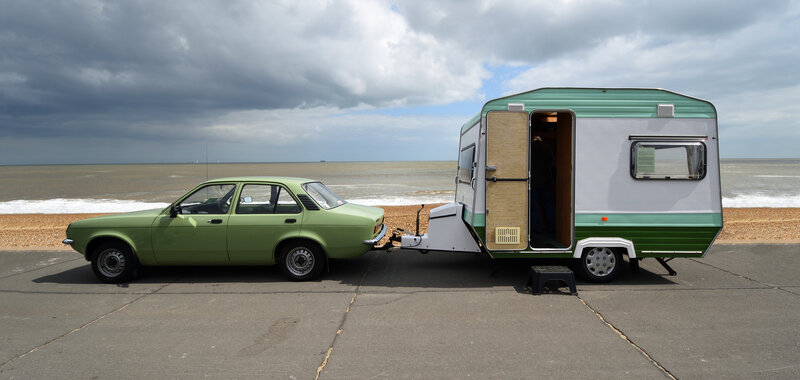
Towing a trailer might look easy from the outside, but it requires a practiced skill set - including spatial awareness. For example, did you know that reversing a trailer requires the opposite steering techniques to get you where you want to go? Steer right to make the trailer go left…but the car still goes right… requiring technique.
And that’s just one of many things drivers towing trailers need to know how to do - and think about - when towing a trailer.
Due to trailer towing snafus, we’ve been to more than our fair share of roadside assistance and towing calls. So, we thought putting together a miniature Trailer Towing Guide would be helpful, including the most important tips on what you need to know and how to keep it safe for yourself and others.
If you’ve never towed a trailer before, or you didn’t grow up with a trailer-driving parent or guardian, we highly recommend taking a class to familiarize yourself with how it feels, along with how to maneuver a trailer safely in a variety of situations.
One of the best ways to learn how to safely tow a trailer is by taking a course that teaches you the basics and offers hands-on classes. Sometimes these courses are offered through trailer and RV dealerships, so you can start there. You can also take in-person classes.
Online options, like RV 101 are also available - providing visual instruction and outlining practice sessions for you to do on your home at home. Finally, friends, neighbors, and family members can be wonderful instructional resources - just make sure they’re good teachers and that they (and you) can remain calm during the training sessions!
Most of the time, towing a loaded trailer requires an SUV or truck with a powerful motor and the right tires. Some SUV crossovers or compact AWD cars can handle a very small or lightly loaded trailer, but not usually on a regular basis.
If you’ll be towing a medium or large trailer, or one that’s heavily loaded, speak to the dealer about which vehicles are the best for the job. Similarly, read your vehicle owner's manual carefully. Most cars capable of towing a trailer have a section pertaining to the trailer, hitch, and electrical hookups to ensure the brakes, turn signals, emergency flashers, and other safety features work correctly.
Most people start out practicing in large empty parking lots. However, you’ll want to take that practice further and begin navigating your trailer in many different types of situations. Start small and safe, practicing on straight stretches of road during off-traffic times.
Then, you should also practice:
The more confident you are in your ability to tow, maneuver, and handle your trailer in various situations, the less likely you are to be in an accident.
One of life’s wisest mottos is “be prepared,” and that motto certainly applies to towing a trailer. Get familiar with some of the most common risks of towing a trailer. That way, you can be prepared for the inevitable (which is bound to happen at some point in your trailer towing lifetime).
Some of the trailer issues leading to the need for roadside assistance include:
The difference in weight between your vehicle - and your vehicle towing a trailer - and your vehicle safely towing a loaded trailer changes how you accelerate and brake. It takes far longer to accelerate and slow down when towing excess weight. While slow acceleration rarely poses a safety hazard, not braking in time poses significant risks.
You should leave far more space between you and the vehicle in front of you when towing a trailer, avoid speeding, and give yourself plenty of time to slow down. This minimizes the risk of a rear-ending accident, dramatic trailer swaying, or jackknifing.
Vehicles and trailers are specific about the parts and equipment they need to function best. Never use equipment that isn’t supposed to be used with your truck/car or trailer. Follow the “rules” set by the manufacturers, as they’re there for a reason.
You safely tow a trailer and drive as if you aren’t hauling one. We witness way too many people driving trucks and trailers as if they were driving a hatchback or on their regular daily commute. This puts everyone’s safety at risk.
Always keep defensive driving at the forefront of all you do, drive at or under the speed limit (rarely over 55 mph in CA for vehicles towing trailers), and give yourself plenty of room to stop or maneuver in the case of an accident or road issue ahead of you.
An unbalanced load is a leading cause of trailer accidents caused by heavy swaying, turnovers, or jackknifing. Trailer weight should be balanced evenly from side to side. Use proper tie-downs and straps if necessary to hold things in place. If you can’t balance it well from front to back, make sure the weight is heavier toward the front of the trailer (the truck/car end of the trailer).
Trailers start to sway very easily, gaining momentum if it’s not carefully corrected. Most trailer swaying is caused by:
Try to avoid swaying in the first place. If your trailer begins to sway, gradually slow down by lifting your foot off the gas or gently tapping on the brakes (resist the urge to brake too hard or fast as that worsens swaying). If you start swaying again and can’t tell why, pull over and inspect the tires, your load, and the trailer connection.
This means the trailer and the vehicle are out of sync and wind up forming a v-shape. If you’re going slow enough, it’s not always a big deal. If you’re diving faster, a jackknifed trailer can cause a serious accident - including the potential to flip the vehicle - even leading to fatalities.
You will need to think ahead and turn on a wider turn radius. As you turn, the trailer's angle means that its wheels are closer to the inside of the curve than your vehicle’s wheels. This should be generously accounted for, or you risk bumping over curves which can overturn the trailer or cause property/people damage.
Did you have an accident while towing your trailer? Have you experienced a tire or mechanical issue and need J&T Towing to pick you up or deliver roadside assistance? We’re here 24/7 to get you safely on your way. Contact J&T Towing at (707) 356-4613 and we’ll get there ASAP.
