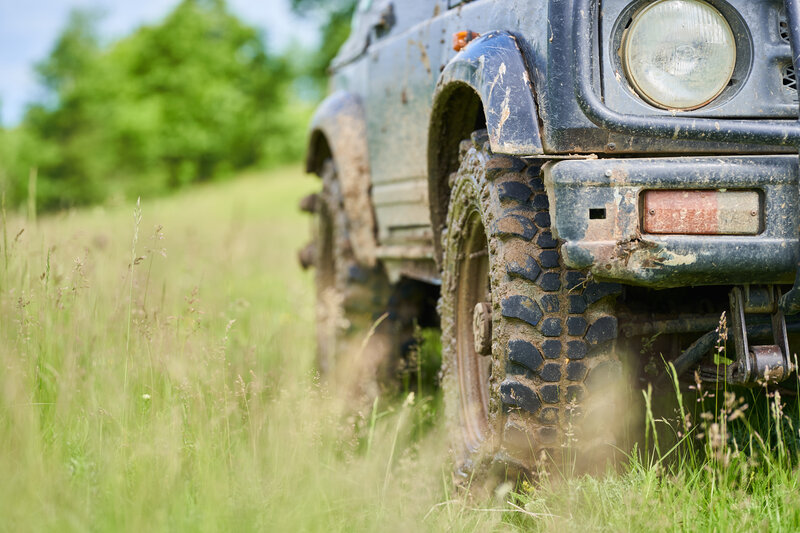
There is a difference between all-wheel drive (AWD) and four-wheel drive (4WD), even though people mistakenly use the words interchangeably. Things have become even more confusing for the non-motor enthusiast because auto manufacturers muddy the waters even further by naming their models in different ways to reference AWD or 4WD features, like BMW’s xDrive or Mercedes-Benz’s 4MATIC.
Most Bay Area drivers won’t ever need a 4WD vehicle, so it’s worth understanding how the different system works as well as the pros and cons of each one.
There are several key differences between AWD and 4WD and how they work.
In an all-wheel drive vehicle, the system delivers varying amounts of torque to each axle, depending on the driving conditions. This allows the vehicle’s tires to experience better grip. Torque distribution occurs via the car, truck, or SUV’s sensors, requiring zero input or decision-making from the driver. This is all done by a center differential to distribute torque to the two axles. Some vehicles have full-time AWD, like most Subaru models. Others, like the Toyota Camry LE AWD, have part-time AWD that automatically switches to AWD under slippery or unpredictable road conditions.
A 4WD vehicle sends a fixed amount of torque to each axle, and the driver handles this by manually engaging 4WD features. Autos with 4WD features have two different modes: two-wheel drive and four-wheel drive. The former is used most of the time in normal road conditions. The driver must follow the manufacturer’s instructions to shift the vehicle into 4WD mode, which should only be done in specific scenarios - such as off-roading, snowy or icy conditions, or when towing a heavy load. A 4WD system uses a transfer case to change the torque once it’s engaged.
This is a very generalized explanation of AWD and 4WD functions. And continuing innovation means there are emerging variances in how the technology works. For example, vehicles like the BMW M5 or the Ford F150 Raptor utilize new technology to provide both AWD and 4WD features.
AWD vehicles cost more than 2WD or those with 4WD options. This is because AWD technology requires an additional computer system, and that costs more. Also, AWD suspensions are slightly larger than 2WD vehicles and require more power. This results in extra materials and parts costs.
Many of the full- and compact-size SUVs are built to tow small trailers and lighter loads, and their AWD features come in handy for this. However, AWD doesn’t have the high-impact grip a vehicle needs for towing heavier loads in a sticky situation.
Typically, trucks towing trailers use 2WD, but 4WD options come in handy if there is a slippery or rugged road condition. Therefore, if you plan to tow a heavy trailer or livestock carrier, 4WD is the safest and best option when you need it.
Off-road enthusiasts and those who live in (or frequently visit) regions with snowy or muddy winters often prefer the 4WD option. Manual 4WD options are best when traversing slippery, unsteady, loose, or rugged surfaces. Once you’re back on normal road surfaces, you disengage 4WD.
Most people driving in the Bay Area opt to purchase all-wheel drive over four-wheel drive. The exception is those who tow or carry trailers on a regular basis or recreational enthusiasts whose adventures take them off-road or into the mountains more than on an occasional weekend.
Have you been stranded on an off-roading trek? Is your AWD in need of a flatbed tow truck? Don’t worry. J&T Towing has you covered. We’ve towed thousands of Bay Area drivers to their homes or preferred mechanic. When you find yourself in an emergency situation and need your vehicle towed or need a quick tire change, we're the team you can count on to get it done right.
Contact us online or give us a call at (707) 356-4613 and we’ll be there to pick you up.
